A new research topic editorial published in Frontiers in Nutrition in April 2026 brings together the latest thinking on one of the most important questions in food systems science: how does the health of our soils shape the nutritional quality of the food we grow — and what does that mean for human health?
The editorial, titled Impact of Soil Health on Crop Nutrition and Human Health, synthesises emerging evidence across soil science, agronomy, and nutritional epidemiology. It illustrates what researchers have long suspected: that the biological communities beneath our feet — the bacteria, fungi, protozoa, and nematodes that constitute a living soil — are inseparable from the nutritional value of the crops that grow in them.
The Soil-Microbe-Plant Nexus
Central to the editorial is what scientists call the soil-microbe-plant nexus: the complex, reciprocal relationships between soil biological life, plant root systems, and the uptake of minerals and secondary metabolites. Mycorrhizal fungi, for example, extend the effective root surface area of a plant by up to 700-fold, dramatically increasing phosphorus, zinc, and iron uptake. Nitrogen-fixing bacteria convert atmospheric nitrogen into plant-available forms. Predatory nematodes release mineral nutrients locked in bacterial biomass.
When these biological networks are disrupted — by tillage, synthetic fertilisers, fungicides, or compaction — the plant's access to micronutrients is reduced. It can still grow, often abundantly, but the nutritional profile of the resulting food is measurably poorer. The editorial documents this mechanism in detail, drawing on field trials and controlled experiments across multiple crop systems and geographies.
From Soil to Human Health
The editorial goes further than most previous syntheses by explicitly tracing the connection from soil biology to human health outcomes. This chain — degraded soil biology → lower mineral and phytonutrient density in crops → increased risk of micronutrient deficiency in populations — is one that Vitagri has been documenting since we began our research programme in 2023.
The Frontiers editorial notes that subclinical micronutrient deficiency — insufficient iron, zinc, magnesium, and selenium at levels that don't cause acute clinical symptoms but that compromise immune function, cognition, and metabolic health — is a growing challenge in high-income countries, including the UK. This is not primarily a problem of food access but of food quality: the food is there, but it contains less of what we need.
Alignment with the Growing Health Report
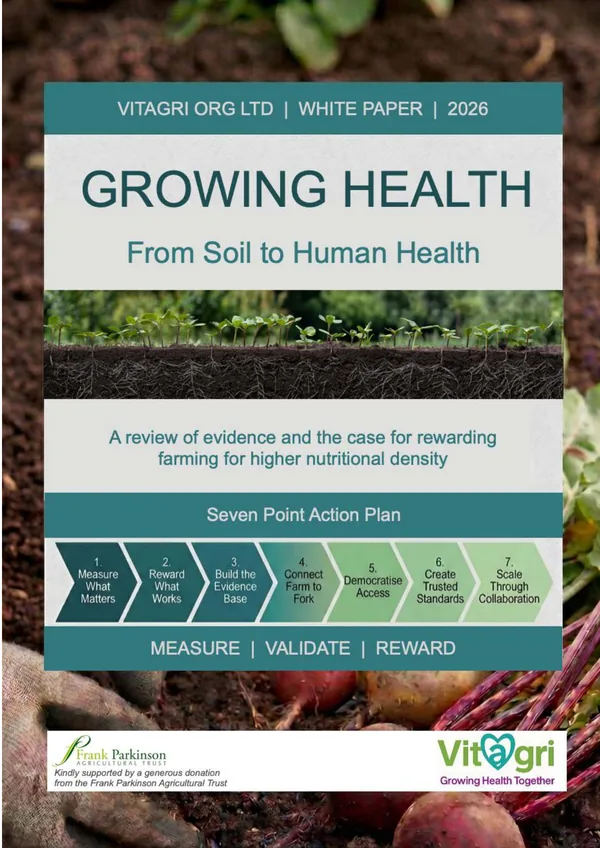
Readers of Vitagri's Growing Health Report will find much of this ground familiar. Chapter 2 of our white paper — Soil Health & Nutrient Density — documents the biological mechanisms linking soil condition to nutritional outcomes in crops, drawing on 3,000+ peer-reviewed studies. The Frontiers editorial adds to this body of evidence and signals that these ideas are moving from the specialist literature into mainstream nutritional science.
Particularly significant is the editorial's emphasis on measurability. The authors highlight the need for standardised tools to assess both soil biological health and crop nutritional quality — precisely the gap that Vitagri's GroundUp Framework is designed to address. Without measurement, there can be no verification, no market signal, and no incentive for farmers to invest in soil health.
Why does soil-nutrition research matter now?
The timing of this editorial is significant. As the UK continues to develop its post-Brexit agricultural policy — including the Sustainable Farming Incentive and the Farming in Protected Landscapes scheme — questions about what we are rewarding farmers to produce are becoming urgent. We currently measure farming outcomes almost entirely in terms of yield, carbon, and biodiversity. Nutritional quality remains absent from the scorecard.
The growing volume of peer-reviewed evidence, including this Frontiers editorial, makes the scientific case for including nutritional quality in agricultural policy ever harder to ignore. Vitagri exists to translate that scientific case into a practical framework — one that farmers, retailers, and policymakers can actually use.
Read the full evidence base in our Growing Health Report